Journal / The Christmas Gift Guide for Wooden Model Kits (2026)
The Christmas Gift Guide for Wooden Model Kits (2026)
Who actually enjoys a wooden model kit, what each budget band buys, how to match a kit to a person, and the mistakes that turn a gift into a cupboard ornament.
A wooden model kit is one of the few gifts that gives someone something to do on Christmas afternoon rather than something to put on a shelf and feel vaguely guilty about. But the category has a wide range, and the cheap end is genuinely bad. Here is how to pick well: what each budget band actually buys, which kit belongs to which person, what to put in the box beside it, and when to order.
Who actually finishes a wooden kit
The honest answer: people who already like making things with their hands. Model builders, hobbyist woodworkers, anyone who has ever finished a jigsaw puzzle and immediately wanted a harder one. If the person you are buying for has never built anything and does not read instructions for fun, a 500-piece mechanical model is not a gift, it is homework.
The reliable signal is patience with fiddly work. Someone who cooks, knits, does embroidery, repairs their own bike, or plays with mechanical keyboards will almost always enjoy a wooden kit. Someone who describes themselves as "not a hands-on person" will not, no matter how good the kit is.
There is a second signal, and it is about time rather than temperament. A kit needs a run of two or three uninterrupted hours to get anywhere. Someone working sixty-hour weeks with small children will look at an open box of laser-cut plywood the way they look at an unread book. That is not a reason to skip the category. It is a reason to buy a smaller kit, or to hand it over in January with a note saying so.
And a third: curiosity about how things work. The person who takes the lid off a broken appliance before deciding whether to replace it is a wooden-kit person. The person who replaces the appliance without looking is not, and would rather have a better appliance.
What the money actually buys
Price in this category has surprisingly little to do with how large the finished object is, and a great deal to do with three other things: the board, the cut, and the manual.
- The board. Thicker plywood holds a press fit and resists the flexing that makes joints drift out of line halfway through a build. Thin board is the most common single reason a kit feels cheap in the hand.
- The cut. A clean laser cut leaves an edge that seats under light pressure. A poor one leaves a fuzzy brown edge that has to be sanded on every single part before anything fits, which turns a pleasant evening into a chore.
- The manual. A manual drawn from a real, built model, with legible part numbers and a diagram for every step, costs money to produce and saves the buyer an entire evening of guessing.
In rough category terms, and not for any particular kit, the bands behave like this:
- Under about $25. The most uneven part of the category. Some small kits here are genuinely good: few parts, generous tolerances, a design that does not depend on precision. Many others are the same object made badly. At this price, judge the listing by the manual and by photographs of the cut edges rather than by the piece count, because nobody is putting 400 pieces of good plywood into a twenty-dollar box.
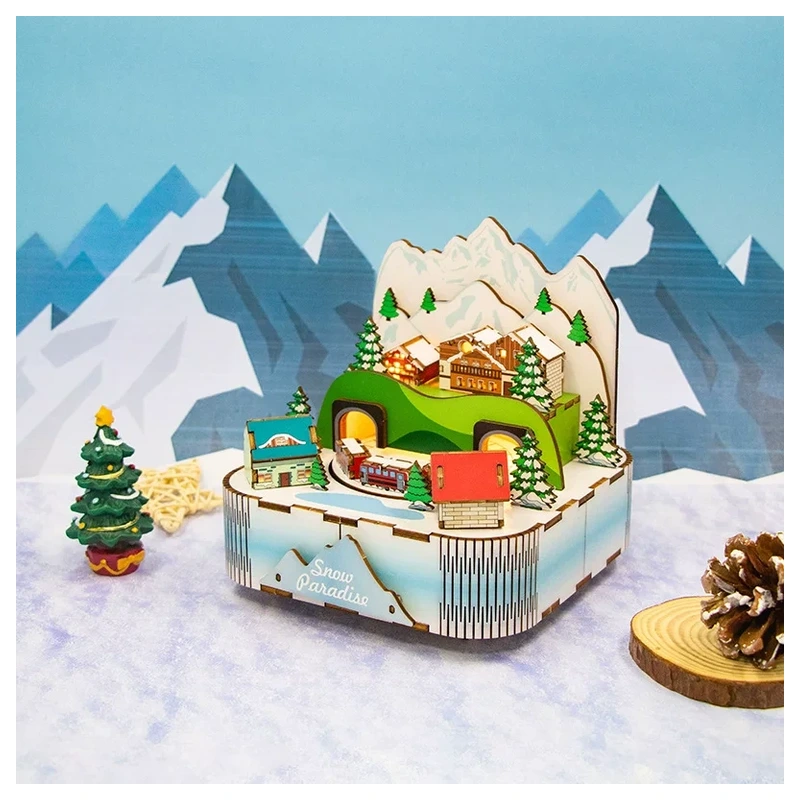
- Roughly $25 to $60. Where the category actually begins. This band buys a real hand-crank movement, a properly engineered marble run, or a lit scene with a wiring channel and a base that sits flat. If you are unsure whether the recipient will take to it at all, spend here: enough quality that a failure would be a surprise, not so much that picking wrong is expensive.
- Roughly $60 to $120. Larger mechanisms, more parts, more metal, more finishing work. What you are buying at this level is hours, not materials. It is the right band for someone who has finished a kit before and whose only complaint was that it ended too soon.
- Above about $120. The top of the range: large mechanical models, elaborate scenes, kits with motors or lighting. Buying here for a first-timer is a mistake almost regardless of budget, because the risk is not that the kit is bad. It is that it never gets finished, and an expensive unfinished kit sits in the room as a reminder of that.
Two patterns worth knowing before you spend. First, the cost per evening of building does not keep falling as the price rises: the middle of the range is often the best value per hour, because the top of the range spends its money on detail that a first build will not notice. Second, a kit that arrives with the small consumables it needs, such as a scrap of sandpaper, a wax candle for stiff joints, or a spare of the parts most likely to snap, is worth more than the price gap suggests, because assembling that list yourself costs a weekend and leaves a drawer full of leftovers.
Match the kit to the person
Type matters more than difficulty. Five kinds of recipient, five different answers.
The reader. A book nook: a shallow, lit miniature scene designed to stand between books on a shelf. It is the best gift in the category for someone whose shelves you have actually seen, because the scene can be matched to the shelf rather than to the person. It is also the most forgiving build, since a slightly imperfect joint disappears into the scene instead of announcing itself. If the shelf is a mystery, choose a scene that also reads well on a desk. There are more themes in these Christmas book nook ideas.
The person with a desk. A music box or a compact mechanical model, for the colleague, the study, the person who spends the day in front of a screen and wants one object nearby that is not a screen. A hand-crank movement is the strongest choice, because the finished object does something: visitors pick it up and turn the crank, which is a better outcome than being admired once. The music box kits are where to look, and how a hand-crank music box works explains what the recipient is actually getting.
The teenager. The trap is buying down. Most good kits in this category are designed for ages 14 and up, and a fourteen-year-old can build one without difficulty; what a teenager will not forgive is being handed something that looks like a children's toy. Buy a real kit from the middle of the range, and prefer one with a mechanism or a light over one that is purely decorative, because the payoff has to be visible to be worth the evening.
The person who already has a shelf of models. Do not buy a bigger version of what they already own. Give them a different material, a different scale, or a different failure mode. If their collection is all static, a visible mechanism is the interesting gift. If their collection is already enormous, something small that takes two evenings beats something big that takes two weeks, because their backlog is the real competition.
The person who wants nothing. This is the recipient the category suits best. They do not want another object; they want an evening that is not a screen. A kit is a gift of a few absorbed, quiet, mildly difficult hours, and then an object they made rather than an object they were given. Spend in the middle of the range and do not apologize for the size.
Ordering in time: how the calendar really works
Three bottlenecks arrive every December, and all three are predictable.
- Stock runs out on specific designs, not on the category. Popular themes are gone by the middle of the month and are not always back the following week. If you want a particular design, decide earlier than feels necessary. If you are choosing late, choose a different theme rather than a bigger kit, because size is not a substitute for the design someone actually wanted.
- Delivery estimates stretch through the last fortnight. Every carrier does this. The final week before Christmas is the week a two-day estimate becomes a guess, so treat any quoted window in that period as optimistic.
- The kit has its own lead time, and it is longer than Christmas Day. A 300-piece build is not a Christmas morning activity for most people. It is Christmas afternoon plus two or three evenings afterwards. Say that out loud when you hand the box over, because a recipient who thinks the model is supposed to be finished by dinner will rush, and rushing is how tabs break.
A workable order of operations: buy the kit first, the accessories second, and the batteries or adapter third, because the kit is the only item that can go out of stock. Order with enough margin that a change of mind is not an emergency. And if you are buying for a household you do not live in, ask where the model will be built before you choose the size, not after.
What to put in the box beside the kit
A kit is a complete gift on its own. A small accessories bundle makes it a better evening, and none of it requires knowing anything about the specific model.
- A quarter sheet of 400-grit sandpaper. Laser-cut edges arrive slightly brown and slightly fuzzy. Two minutes of sanding on a stubborn tab is the difference between a joint that seats and a joint that splits.
- A small craft knife or hobby blade. For the tiny nubs left where a part was attached to its sheet. Snapping parts out by hand works right up until it does not.
- A shallow tray or a rimmed plate. The least glamorous item here and the one that saves the most time, because a part that rolls off the table is a part that stops the build.
- Glue, but only if the kit calls for it. Plain white wood glue, applied with a toothpick, rather than a fast-setting cyanoacrylate, which dries brittle and will crack the parts under load. Whether a given kit needs glue at all is a question the listing should answer, and the general rules are in do wooden 3D puzzles need glue.
- A cutting mat or a sheet of card. To protect the table. A build that damages the dining table is a build that gets banned.
Wrap the accessories separately and label them, or they will be lost in the paper and the recipient will start the build with a pair of kitchen scissors.
Building it together is part of the gift
The strongest argument for a wooden kit at Christmas is not the finished object. It is that the gift arrives with a shared activity attached, and one that does not require anyone to be good at anything.
A kit on a table is an invitation. Two people can work on it, one reading the manual and hunting parts while the other assembles, and that division of labour is genuinely faster than one person doing both. It also solves the specific problem of a gift for a parent, a sibling, or a partner who has reached the age where they buy themselves whatever they want: the kit is not a thing, it is an evening with you inside it.
Three practical notes for building as a pair. Read the whole step aloud before either of you touches a part. Keep the sheets in numerical order and put every unused part back on its sheet, because a loose pile is where parts disappear. And when a joint resists, stop and check the orientation before pushing harder. Almost every snapped tab is a right part in a wrong slot, and while a broken wooden piece is usually fixable, it is better not to need the page.
Four ways a kit gift goes wrong
Buying the cheapest version. The low end of this category is defined by thin boards, fuzzy laser-cut edges, part numbers engraved on dark wood where nobody can read them, and instructions that were clearly never tested against a real build. The failure is not cosmetic: cheap kits break at the joints, and a broken piece ends the build. Pay for the middle of the range.
Buying difficulty as if it were generosity. This is the classic Christmas error: a 600-piece kit for someone who has never built anything, chosen because the box was bigger and the price was higher. A beginner does not need a challenge, they need a first win. The 600-piece kit reaches step nine and goes into a cupboard, and the recipient concludes that they are not good at this, which is the wrong lesson taught expensively. Match the kit to their experience, not to your confidence in them.
Assuming it is a toy for a child. Most good kits in this category are designed for ages 14 and up, and the mechanical ones are really aimed at adults. A box labelled for 6-year-olds is a different product made of the same material.
Forgetting that the kit needs a table. Someone in a small flat with no desk may genuinely have nowhere to leave a half-built model for three days. Ask where they would build it. If the answer is "the floor", buy a smaller kit.
If you are buying for someone who has everything
This is the person wooden kits are actually best for, and the reason is not the object. The person who has everything has run out of things. What is left to give them is time: specifically, a few hours in which their hands are busy and the phone is face down, followed by something on a shelf that they made themselves. That is a different category of gift from anything bought finished, and it is very hard to buy twice by accident.
If you have narrowed it down to a type but not a design, the Christmas gift selection is organized around the same questions this guide asks. If the answer is still "something for a reader", the book nook section is the safest place to land, and if the recipient has no shelf at all, a desk-sized scene or a music box covers the same ground.
One last thing, which matters more than the model: write on the card what the kit is and how long it takes. A box of laser-cut sheets with no explanation looks like a puzzle. A box with a note saying that this is a two-evening build, to start it on the 27th, looks like a plan, and a plan is a better gift than a model.
Applies to: Book Nook Kits · Wooden Christmas Gifts
Kits in this article
Each kit links to its own page with the full specification.
If you are stuck mid-build
Our build guides cover the two things that actually go wrong: a marble run that will not run and part numbers you cannot read.